Showing posts with label spiritual growth. Show all posts

Sunday, September 15, 2013

Support System Sunday

-->According to the Bible, it is our responsibility to console, support and protect others during hard times.

Gal. 6:2 tells us: Go on carrying the burdens of one another, and thus fulfill the law of the (Divine Light/) Christ

Each of us can contribute to the well-being and growth of those around us, and beyond.  How do we do accomplish this responsibility?  We do this by striving to be, at all times, a source of encouragement and spiritual refreshment to others.

So, then, let us pursue the things making for peace and the things that are upbuilding to one another. Rom. 14:19   Above all things, have intense love for one another, because love covers a multitude of sins.  Be hospitable to one another without grumbling.  In proportion as each one has received a gift, use it in ministering to one another as fine stewards of God’s undeserved kindness expressed in various ways.  1 Peter 4: 8-10

Let us always be ready and willing to assist others.  Let us share as much as we can, as circumstances allow.   Let us be cheerful givers.  

2 Corinthians 9:6-7 reminds us: But as to this, he that sows sparingly will also reap sparingly; and he that sows bountifully will also reap bountifully. Let each one do just as he has resolved in his heart, not grudgingly or under compulsion, for God loves a cheerful giver. 

It is up to each us to do the work to connect with others; no one can do it for us.  Sometimes this responsibility to our brothers and sisters can feel overwhelming, especially when fulfilling this responsibility interferes with our own wants and/or needs.  When this happens, let us remember that we are never really alone; the Creator/God, the Divine Light/Jesus and other Spirits are with us.  
Let us take our problems to the Creator/God.  Just as it is up to each us to do the work to connect with others, it is up to each of us to make the connection with the Creator/God.  Sometimes we allow ourselves to get so disconnected and frazzled that we can not reconnect.  The Creator/God knows this and recommends having a support system; it is vital to our success.   Success in most endeavors is a team effort, not a solo performance.      
Proverbs 15:22 states: There is a frustrating of plans where there is no confidential talk, but in the multitude of counselors there is accomplishment. 

A support system is a network of people who interact and remain in informal communication for mutual assistance; members of the network provide practical, emotional and/or spiritual support which sustains other members in their survival and growth, on an as needed basis. 

Successful support systems typically consist of a minimum of 3 people.   There are 2 main, beneficial, reasons for this:

1.     No one is available 24/7; the more people in our support system, the better chance we have of receiving the assistance we perceive we need. We will not always be there to shield others from life’s challenges. 
2.     When we stay focused on the goal of teaching another to stand on his/her own two feet, we are given the opportunity to help empower them.   

To help us stay focused on this goal, we can ask ourselves the following questions:
1.     What can the person asking for help reasonably do on their own? 
2.     Are there things we (the support system) are doing for this person, that they could do for themselves?   If yes, work with the person until sure that they can handle the responsibility on their own. 
3.     How much can each of us reasonably assist this person?
4.     What are our own personal boundaries?
5.     What are our support system group boundaries?
6.     What are the consequences to individual group members, the group at large and to the other person if the boundaries are not respected? Outline potential consequences of actions: good and bad.  In a very covert way, accepting the consequences of our actions helps us learn to rely on support only when necessary.  A good support person will not support a brother or sister in staying stuck.

For each one will carry his own load. Galatians 6:5

At times, we all need support. Let us never hesitate to accept help when struggling to cope.  Keep in mind, however, that if we do not trust a person, they really have no place in our support system.  People in our support system are the people, who, over time, get to know us; the real us.  In an effort to receive assistance, we often find ourselves sharing dis-harmonious/dis-eased thoughts and/or gut-wrenching emotions.  We must be able to trust those with whom we open up to and share our real “earthly” selves with. 

If a support person offers suggestions or options to assist us, we may choose to ignore them … If 2 support people tell us the same thing, it is usually in our best interest to listen … If 3 or more support people tell us the same thing, it is in our best interest to quit whining and take action by following or trying any suggestions or options given. 

Not all options or suggestions given, will work.  This does not mean that we should not do the footwork and try to implement them though.  When we shoot them down automatically, we disrespect and thereby abuse one or more members of our support system.   Let us be willing to do whatever it takes to move forward. 

Let us always accept any support we receive, with appreciation.  Let us never be demanding when asking others to help us handle our problems. Let us be reasonable in how much of their time and attention we expect them to give us.  Let us remember that our brothers and/or sisters may be unable to meet our needs.    

When this happens, let us continue to take our problems to the Creator/God and have faith that the Creator/God will sustain us in whatever trials we may face.

Whether we are giving or receiving help, let us do so in the right spirit.

So it is, sealed in trust, faith and truth, in the Sacred Divine Light/Jesus. Amen.

Please leave comments to this post on our Facebook Page.  Thank You!


Sunday, June 9, 2013

Stewardship: Part 3 of 3


This is the 3rd of 3 Discourses on Stewardship.  Part 1 was a brief attempt to Inform the Public.  Part 2 discussed The Spiritual Aspects of Stewardship, and Part 3 will provide some action steps we can take to be better Earth Stewards.


Part 3:  Actions Steps to be Better Earth Stewards


From the state of our environment, it would be easy for an outsider to conclude that humans, here on Mother Earth, tend to give a whole lot of lip service about doing the will of the Creator/God; we go to church; we pray; we meditate …

As we discussed last week, all who serve the Creator/God are Earth Stewards.  To tend and take care of Mother Earth and all her inhabitants is a great honor and privilege, as well as a great responsibility. As a whole, humans are not living up to our spiritual responsibility.  Instead, we tend to blame others.  We blame our government; we blame our neighbors; we blame big business; we blame everyone but ourselves. 

We may or may not vote at the polls; we still vote though.  Every time we make a purchase, we cast a very important vote.  You see, we vote with our dollars.  When we purchase, oh say, Styrofoam cups, we unconsciously cast a vote against the Creator/God and Mother Earth.  

As we grow personally and develop spiritually, we consciously take better care of ourselves.  As we take care of ourselves better, we come to be aware of our votes and strive to cast votes in harmony with our inner state of being.  There is no more blame, only harmony. 
 

“… it is who we become that changes the world and our environment not what we do.  Harmony within will create harmony without.  So the true work is learning how to change our thoughts, attitudes and belief systems … We actually have to work with “the alchemy of the soul” to really be able to change our inner environment as our inner state of being is reflected back to us in the outer world. The literal definition of alchemy is “working within and through the dense darkness inside.” This is big work and involves committing to spiritual practices that we must engage in daily and throughout the day.”  Sandra Ingerman

There are many things that we can physically do to help ourselves and the environment.  The following information is not meant to be exhaustive.  If you have a favorite tip or DIY recipe, please share it on our Facebook Page.   Thank You!
 

Personal: Avoid wearing harsh synthetic fabrics, like polyester. Avoid artificial fabric dyes; instead, make your own.  Use organic, renewable agricultural products, like Bamboo and Hemp.  Purchase or make your own natural Health & Beauty products (soap, shampoo, conditioner, toothpaste, deodorant, lotions, cosmetics, perfume/cologne, etc.).   Avoid processed foods; instead make your own.  Shop at Farmer’s Markets and get to know the vendors. When leaving a room, turn off lights and appliances. Unplug electronics, and turn down your thermostat, before leaving the house or going to bed.   Pick up your pet's poop and dispose of it properly. Pick up and throw away litter/trash. When it’s hot, gas up vehicle(s) and other gas powered equipment (like lawnmowers) early in the morning or later in the evening, and don't top off the gas tank.   Replace toxic household cleaners with products that have a Design for the Environment (DfE) label.  Better yet, learn to make natural cleansers.  

Practice the three R's:

1.     Reduce how much you buy and use: Buy permanent items instead of disposables.  Buy and use only what you need.  Buy products in bulk.  Buy products with minimal packaging.  Buy products that use less toxic chemicals. Use durable (real) plates, cups, silverware, etc. Use cloth napkins or towels. Mend torn fabric. Repair broken items. Reduce Carbon Footprint (Walk, Cycle, Carpool, Use Public Transit, Work from Home, Shop Online, Consolidate Trips.)

2.      Reuse/Repurpose: Be Creative.  Make crafts and homemade craft supplies using household or recycled materials Use empty jars for leftovers/storage containers. Give Away/Donate useable items.

3.      Recycle:  Aluminum Cans, Batteries, Cardboard, Electronics (cell phones, computers, DVD players, and other electronics),Glass, Paper (newspapers, catalogs, junk mail, etc.), Metal (Aluminum, Scrap Steel, Copper, Gold, Silver, etc.); Plastic (food containers, dry cleaning, newspaper & bread bags; plastic around toilet paper/paper towels, etc.).  Tires, Used motor oil.  

Perform a home audit: Replace conventional light bulbs with compact fluorescent or LED bulbs. Repair leaky faucets.  Insulate water heater and pipes. Install a water-efficient showerhead.  Repair or replace old or damaged fixtures.   When replacing fixtures and/or  other products, look for Energy Star or WaterSense labels.
 

Conserve Water: When using a dishwasher, scrape plates instead of  pre-rinsing them.  When using a dishwasher or washing machine, wash a full load.  Wash clothes in cold water.  When hand-washing dishes or clothes, turn the water off between rinses.  Instead of using a clothes dryer, hang clothes on a line or drying rack. Take Showers instead of baths.   The toilet does not need to be flushed, every time it’s used.   “If it’s yellow, let it mellow.  If it’s brown, flush it down.” Turn the water off while shaving or brushing teeth. Refrigerate drinking water.
 

Lawn & Garden:  Invest in, or make your own compost bin, and compost as much as you can.  When mowing, do not bag grass clippings; leave them on the lawn. Fertilize after, not before it rains. Instead of using pesticides and herbicides, weed by hand, purchase or make your own natural pest control products, attract and utilize beneficial insects in your garden(s). Water the lawn or garden during the coolest part of the day (early morning is best).  Set sprinklers to water the lawn or garden only - not the street or sidewalk. Use a soaker hose or trickle irrigation system to water trees. Install gutters and rain barrels. 

Let us continue to grow personally and develop spiritually; let us consciously take better care of ourselves; let us be aware of our votes; let us cast votes in harmony with our inner state of being;  let us pray: 

Dear Mother, our human species, thanks to the precious gift of awareness, has been able to learn to recognize its own presence and has found its true place in you and in the Universe. We know that we are tiny and insignificant, yet our minds are capable of encompassing three thousand worlds. We now know that our beautiful planet Earth is not the center of the Universe but we can still see that it is one of the Universe’s most wondrous manifestations. We have developed science and technology, discovered reality’s true nature of no-birth and no-death, neither being nor non- being, neither increasing nor decreasing, neither the same nor different. We realize that the one contains the all, the greatest is in the smallest, and each particle of dust contains the whole Cosmos. We are learning to love you and our Father more and to love one another in the light of such insight. We know that this non-dualistic way of seeing things and the teaching of inter-being help us to transcend all discrimination, all fear, jealousy, hatred, and despair. We aspire to transmit this insight to future generations.

We are no longer naive in thinking that humans are the masters of the Universe. Many of us have gone beyond dualistic views of right and wrong and are no longer puzzled about what we used to call the Will of Heaven and Earth.  We have transcended the concept of a creator in human form– we are no longer able to believe that God is an old man with a white beard, sitting in the sky, controlling everything on Earth, or that there is a Goddess on a cloud, finding and helping us every time we are in danger. God, for us, is the Ultimate Reality, the true nature of no-birth, no- death, no-coming, no-going, of all phenomenal manifestations. But some of us, when going through suffering, believe absolutely that whatever brings suffering is evil and whatever brings happiness is good; not knowing that suffering and happiness are just perceptions. All our perceptions are based on our sense organs, which are inherently limited. If our sense organs were differently formed, then our perceptions would be correspondingly different. Thus we see that happiness or suffering, the Pure Land or the mundane world depend very much on our way of perceiving. (Thich Nhat Hanh, Intimate Conversations with Mother Earth)

 So it is, sealed in trust, faith and truth, in the Sacred Divine Light/Jesus. Amen.


Sunday, April 7, 2013

The Tetragrammaton


The Creator’s/God’s name appears almost 7,000 times in the original Hebrew Scriptures (the Old Testament). It appears 8 times, just in the 10 Commandments.

One of the most fundamental and essential features of the biblical revelation is the fact that God is not without a name:  he has a personal name, by which he can, and is to be, invoked.”  (The New International Dictionary of New Testament Theology.  Vol. 2. p. 649)

According to Biblical Scripture, the Creator’s/God’s name was used by Adam and Eve, and they knew how to pronounce it.


I have produced a man with the aid of 


 Genesis 4:1


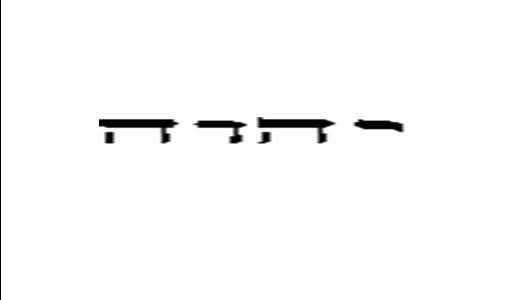
By the time Moses was born, the scriptures imply that no one remembered the Creator’s/God’s Name.  In the original Hebrew Scriptures, the Creator’s/God’s name was given to Moses on Mount Sinai, as being  .   


 (Exodus 3:14).   These 4 letters make up what is called the Tetragrammaton. 

Christians later changed the Tetragrammaton to 


(YHWH) 


And God proceeded to speak all these words, saying:“I am 


your God, who have brought you out of the land of Egypt, out of the house of slaves. You must not have any other gods against my face.  Exodus 20:1-3

Then Moses said to God, "If I come to the people of Israel and say to them, 'The God of your fathers has sent me to you,' and they ask me, 'What is his name?' what shall I say to them?" God said to Moses, "I AM that I AM".  And he said, "Say this to the people of Israel, YHWH has sent me to you.'" God also said to Moses, "Say this to the people of Israel, 'I Am, the God of your fathers, the God of Abraham, the God of Isaac, and the God of Jacob, has sent me to you': this is my name for ever, and thus I am to be remembered throughout all generations. When Moses first spoke with God, God said, 'I used to appear to Abraham, Isaac, and Jacob as El Shaddai  (El: One of God’s earliest names; Syrian tablets with this name have been traced back to 2300 BC; “I AM”), but I did not make myself known to them by My Name YHWH.  Exodus 3:13-15, 6:3.

The Torah conveyed the proper name of the Creator/God distinctly as YHWH to the Israelites; however, in ancient Judaism, the Tetragrammaton, was considered to be so sacred that it was not permitted to be pronounced aloud, even in prayer, without first receiving special permission. Whenever they saw YHWH in the Torah, they replaced it with the descriptive title:  "Sovereign Lord” or “The Lord" (Adonai or Adho-nai). In more recent history, this belief system has been challenged, and the prohibition of guarding the use of the Creator’s/God’s name has become much more relaxed.
Most modern day translations render the Tetragrammaton  as either YHWH or JHVH.   
The truth is, no one knows for sure how the Creator’s/God’s name is/was originally pronounced.  Although much confusion remains as to the correct English pronunciation, most modern day Bible translators render the pronunciation of  the Creator’s/God’s name as "Yahweh” or “Jehovah.” 
The Church of Yahweh renders the following paraphrased hypothesis:
Originally, Hebrew did not have vowels. Eventually the Hebrews felt it was wise to insert little dots (called vowel points) around the letters to remind the reader of the exact pronunciation. When they came to YHWH in the text, they added the vowel points for Adonai ("Lord") to remind the reader that the Divine Name was not to be pronounced. In the Middle Ages, around 1500, translators misunderstood that the vowel points were for "Adonai", not "Yahweh".  Thus, they combined the letters of YHWH with the vowels of Adonai. The result was "Jehovah" … the etymological fact is that "Jehovah" is a mistranslation based upon a historical misunderstanding.  In our modern Bibles, then, whenever YHWH is found, we usually "translate" it as LORD or Jehovah. Both are wrong, though Jehovah is certainly preferable to LORD.
Jehovah’s Witnesses support this hypothesis. 
When it came to God’s name, instead of putting the proper vowel signs around it, in most cases they put other vowel sounds to remind the reader that he should say ‘Adho-nai’.  From this came the spelling Iehouah, and, eventually, Jehovah became the accepted pronunciation of the divine name in English.  (The Watch Tower Bible and Tract Society of Pennsylvania.  The Divine Name That Will Endure Forever. 1984. p. 8)
Does it really matter whether we pronounce the Creator’s/God’s name as Yahweh or Jehovah?  Not at all; if it, the pronunciation, really mattered, the Creator/God certainly would have seen to it that it was preserved by at least one prophet!  The important thing is to know that the Bible does indeed, tell us that the Creator/God has a personal name and we should not only be aware of it, but also use it and share it with others.
Those knowing your name will trust in you … Psalm 9:10
Let your name be sanctified.  Matthew 6:9
I have made your name known to them and will make it known, in order that the love with which you loved me may be in them and I in union with them.  John 17:26
So it is, sealed in trust, faith and truth, in the Sacred Divine Light of Jesus.   Amen

Please leave any comments to this discourse on our Facebook Page.

Sunday, March 10, 2013

This Little Light of Mine …


This Little Light of Mine …

Was written around 1920 by musical composer and teacher, Harry Dixon Loes. Although many think of it as a Negro spiritual, it has never been found in any 19th century jubilee or plantation collection.  In 1939, the song entered the folk tradition. In the 50’s and 60’s, it became the anthem for the Civil Rights movement.

No one seems to know for certain, the true history behind the lyrics.  It has been speculated by many/most to be based upon one or more of the following scriptures:

"You are the light of the world. A city cannot be hid when situated upon a mountain.  Neither do men light a candle and put it under a bushel, but on a candlestick; and it giveth light unto all that are in the house. Likewise, Let your light shine before men, that they may see your fine works and give glory to your Father who is in the heavens."  Matthew 5:14-16  

"After lighting a candle, a person puts it, not in a vault nor under a bushel, but upon a lampstand, that those stepping in may behold the light." Luke 11:33 

In the song, we shine our light so bright that all the world can see, every day, in every way; we are not hiding our light from the world under a bushel basket; we are not letting it dim or go out.

Sometimes though, without our even noticing it, our light begins to dim. When this happens, we often want to retreat from the world, and hide our light.  If we allow ourselves to get to this point, we often begin to feel that we are alone in the dark.

It is universally agreed upon that any/all of the following have the ability to dim our light.

  • People who are negative/Criticize us
  • Negative/critical self-talk
  • Being over-tired
  • Over committing ourselves to anything
  • Agreeing to do things our heart isn’t in
  • Acting like a martyr
  • Overindulging in junk food, sex, drugs and/or alcohol, etc.
  • Being false to our true spirit
  • Being stuck in clutter, disorganization and/or confusion.

Keeping our light shining brightly requires personal dedication and commitment.  Once we become aware of our own inner light, we need to respect it and honor it, by keeping an eye on it and cherishing it; we need to put the welfare of our inner light above any/all other things.  If we do not do this, unwanted dimness has a way of creeping in.

Allowing for some individual variation, here are some things we can do if we find our light starting to dim. 
  • Listen to Motivational music.
  • Watch Motivational videos
  • Read Motivational books, articles, etc.
  • Spend time with Inspiring, positive people
  • Engage in Positive self-talk
  • Eat Healthy nutritious food
  • Get enough Sleep
  • Exercise regularly
  • Get plenty of fresh air
  • Engage in hobbies/activities that are fun
  • Stimulate the Creative part of our brain
  • Help someone with something … ANYTHING
  • Make a difference
  • Move forward on a goal
  • Work toward making our Dreams … our Reality
  • Live authentically

"Our deepest fear is not that we are inadequate. Our deepest fear is that we are powerful beyond measure. It is our light, not our darkness, that most frightens us. We ask ourselves, who am I to be brilliant, gorgeous, talented, and fabulous? Actually, who are you not to be? You are a child of God. Your playing small doesn't serve the world. There's nothing enlightened about shrinking so that other people won't feel insecure around you. We are all meant to shine, as children do. We are born to make manifest the glory of God that is within us. It's not just in some of us, it's in everyone. And as we let our own light shine, we unconsciously give other people permission to do the same. As we are liberated from our own fear, our presence our LOVE automatically liberates others." Speech by Nelson Mandela, written by Marianne Williamson 

We can keep our own personal, little light lit and shining brightly, every day, every way.  We do have a choice. 

Let us choose to be a beacon of light for those who are stumbling or lost in the darkness.   Let Your Light Shine (youtube video)


So it is, sealed in trust, faith and truth, in the Sacred Divine Light/Jesus. Amen

Sunday, February 3, 2013

FORGIVENESS: Part 2 of 2


It is impossible to maintain successful relationships without forgiveness.  Without forgiveness, resentments and mistrust grow.  Resentments and mistrust act as toxic poisons and kill (destroy) relationships. Be quick to forgive.

Let the sun not set with you in a provoked state.   Ephesians 4:26

What if we are unable to forgive quickly?  Emotional wounds take time, love and patience to heal.  Love and patience help us to forgive someone whom we perceive is really trying.  

It serves us well to remember to ask the Creator/God to cultivate a forgiving spirit toward any offender who makes an honest effort to alter their thoughtless, unkind, harmful words and/or actions, and sincerely asks for our forgiveness. 

Hmmm … We ask for a forgiving spirit … What does that mean?

When we are on the receiving end of thoughtless, unkind, harmful words and/or actions, it can be difficult for us to allow these words and/or actions to pass through us,.  This is  due, largely in part, because reactions to personal offenses are usually emotion based reactions.  Emotional responses to perceived offenses can range from mild to strong; it is not uncommon for us to feel angry or betrayed; we may even desire justice or revenge. 

When we are hurt by others,  we often want to retaliate and hurt them back in some way, as pay back.   We can reduce anger and other negative emotions with understanding, open-mindedness, a willingness to forgive, and love for one another.  

When others offend us, being willing to forgive, out of love, keeps us from automatically assuming that anothers motives are bad.    

Above all things, have intense love for one another, because love covers a multitude of sins.  1 Peter 4: 8

Continue putting up with one another and forgiving one another freely if anyone has a cause for complaint against another. Even as Jehovah freely forgave you, so do you also. But, besides all these things, [clothe yourselves with] love, for it is a perfect bond of union.  Colossians 3:13-14

Determining why we are upset reduces our emotional responses.  Using our rational mind to analyze offensive words and/or actions, and understanding the reason(s) for our reaction, allows us to consider what would be the most appropriate response. 

Do not hurry yourself in your spirit to become offended, for the taking of offense is what rests in the bosom of the stupid ones.  Ecclesiastes 7:9  

Taking time to calm down and view the situation from the position of an “objective observer” helps us to remain open-minded and respond more appropriately. When we remove our subjective, emotional selves from the picture and examine the scenario as objective observers, we find that many negatively perceived words and actions flow right through us.  The more  we practice taking our subjective, emotional selves out of the picture, the more we will see that most of the things that are said or done to us, is not personal; it is not about us.   This objectiveness helps us see that others typically are not being deliberately hurtful or thoughtless; our offenders are simply being their imperfect human selves. 

He that is slow to anger is abundant in discernment, but one that is impatient is exalting foolishness.  Proverbs 14:29 

The insight of a man certainly slows down his anger, and it is beauty on his part to pass over transgression  Proverbs 19:11  

Know this, my beloved brothers. Every man must be swift about hearing, slow about speaking, slow about wrath; for man’s wrath does not work out God’s righteousness.  James 1:19-20  

By maintaining a positive view of our offender, in spite of what they are saying or doing to us, we build them up, rather than tear them down.  When we reflect back to them what we perceive they are putting out, we give ourselves, and them, an opportunity to clear up misunderstandings; each is also given the opportunity to gain/maintain control over their own behavior.  What a gift!

Therefore keep comforting one another and building one another up, just as you are in fact doing.  1 Thessalonians 5:11

We each have that power within us to create love, joy, peace and contentment, within our own hearts.  Learn to forgive.  If anybody upsets us, don’t take it to heart, forgive them.  If we have any ill-feelings, any grudges, please forgive them.  Forgive them,  that's the only way we can go forward and go on with our life. Grandmother Agnes (13 Indigenous Grandmothers) 
 
So it is, sealed in trust, faith and truth, in the Sacred Divine Light (Jesus Christ). 
Amen 

Sunday, January 27, 2013

FORGIVENESS: Part 1 of 2


Forgiveness involves the act of pardoning an offender, letting go of any resentment (based on judgment, revenge, persecution and/or anger), brought upon by a perceived wrong doing to us, by another, and giving up all claim to re-compensation.  The Greek term a·phi′e·mi literally means “let go of.”

Forgiveness is a gift that we give to ourselves; there is a strong relationship between forgiveness and mental health; forgiveness lightens our load and helps us maintain our own inner peace.  Forgiveness is essential, if we are to maintain peaceful relationships with others.  Through forgiveness, the bonds of personal relationships are strengthened.  When we forgive, our relationship with the Creator/God is strengthened and we are blessed with peace and contentment.

When we harbor feelings of judgment, revenge, persecution and/or anger, we slowly poison ourselves with toxic thoughts and emotions. As a result, we repeatedly suffer from poor health, broken relationships, stress, and/or communication difficulties. We lower our vibrational frequency to a level which limits: our ability to ascend to a place of inner peace, love and gratitude, as well as our re-connection with the Creator/God and the Divine Light/Jesus.  

Though we may have suffered at the hands of another, what has happened has happened ~ Let us not allow the behavior of others, to rob us of our happiness, by dwelling on negative thoughts and mentally ruminating over how we have been mistreated.  Let us not allow such thoughts to control our thinking.  Let us move on so we can be at peace, and heal.

Do not let yourself be conquered by the evil, but keep conquering the evil with the good.  Romans 12: 21

Some people with whom we are in personal relationship with, are repeatedly unkind to us.  Forgiveness does not mean that we approve of their behavior or minimize any damage created by their behavior.  Having said that, it is in our best interest to maintain a positive relationship with this person, by not keeping track of any wrong doings this person may have already done to us.  We all stumble in word and in deed on a regular basis. 

For we all stumble many times. If anyone does not stumble in word, this one is a perfect man, able to bridle also [his] whole body. James 3:2  
   
The offender, like each of us, is a victim of human imperfection.  With this realization, we can then allow ourselves to imagine the motivating pain and/or suffering behind the perceived wrong-doing behavior.  When we can imagine this, we can forgive more easily.   

One of the greatest things that any of us have, is prayer.  It is hard to stay angry with someone, for very long, when we are praying for them, so pray for the offender.  

“Continue to love your enemies and to pray for those persecuting you.”  Matthew. 5:44.

If a person asks for forgiveness, it will serve us well to keep in mind that, if the shoe were on the other foot, we would want the other person to forgive us.  It will also serve us well to do the same for our offender, no matter how often it happens.  Forgiving others for personal offenses, regardless of the number of times involved, is a Christian requirement; there is no arbitrary limit on forgiveness.

Then Peter came up and said to him: “Lord, how many times is my brother to sin against me and am I to forgive him? Up to seven times?” Jesus said to him: “I say to you, not, Up to seven times, but, Up to seventy-seven times.”  Mathew 18:21-22

Pay attention to yourselves. If your brother commits a sin give him a rebuke, and if he repents forgive him. Even if he sins seven times a day against you and he comes back to you seven times, saying, ‘I repent,’ you must forgive him.”  Luke 17:3-4

There are times when a person might intentionally hurt us; there are also times when an offender may not be remorseful or ask for forgiveness.  The Creator/God prescribed a way for seeking and receiving his forgiveness. A person must acknowledge and confess his/her wrong-doing, recognize that it was an offense not just to another person, but also against the Creator/God, feel deep heartfelt sorrow and remorse, be determined to change his/her ways, and to the best of his/her ability, fix any damage done. It matters not how far one falls, but the strength of his/her determination to set matters right, rise above the wrong-doing, and move forward.

When we encounter a non-remorseful offender, it is in our best interest to lovingly release the person to the Creator/God, leave the relationship, and move on with our life.  Although divine forgiveness is expansive and generous, the Bible states that we should not pray for those sinning against the Holy Spirit, with no repentance, as this is a deliberate practice of malicious, willful sin, for which there is no forgiveness. 

On this account I say to YOU, Every sort of sin and blasphemy will be forgiven men, but the blasphemy against the spirit will not be forgiven.  Matthew 12:31 

It is important to remember, that when we release a person to the Creator/God, and walk away, that we do so lovingly, and without judgment.  By imitating the Creator’s/God’s attitude toward forgiveness, we step out of the picture and allow the Creator/God, to examine the offender’s thoughts and heart and guide us on our path. 

Trust in Jehovah with all your heart and do not lean upon your own understanding. Proverbs 3:5  

Return evil for evil to no one. Provide fine things in the sight of all men.  If possible, as far as it depends upon YOU, be peaceable with all men. Do not avenge yourselves, beloved, but yield place to the wrath; for it is written: “Vengeance is mine; I will repay, says Jehovah.”  Romans 12:17-19

So it is, Sealed in Faith in the Divine Light/Jesus ... Amen


Sunday, January 6, 2013

Reasonableness

-->
In the Bible, the word “reasonable” relates to the concept of being considerate, and conveys a sense of not being too strict.   Many people believe that they always need to do more, do better, or be better.  If we strive to attain unreasonable goals regardless of the cost, we subject ourselves to unnecessary stress.  Developing a reasonable view of what we CAN do, will greatly reduce our day to day stress levels.

Many of us are able to view others reasonably (with consideration), yet we find it very difficult to be considerate with ourselves. When we are reasonable, we are able to view our own circumstances in the same objective, balanced manner in which we view others.  To have a reasonable view of our own limitations can be challenging. 

We need to learn to recognize the signs that may tell us when we are approaching our own limits.  Proverbs 11:17

Once we identify our perceived limitations, it is not in our own best interest to become too lenient with ourselves, using our limitations as an excuse for doing less than we are capable of.  Though self examination and self adjustment can be challenging, it brings rich blessings.  Remember, the Creator/God never asks more of us than we can give. 

Just as it is not in our best interest to become too lenient with ourselves, it is not in our best interest to continue to focus our attention on our limitations.  To do so, prevents us from seeing what IS within our reach. 

It is to our benefit to do our best to make an honest appraisal of our abilities and limitations, and then cultivate reasonable expectations in light of our personal abilities and circumstances.  When we discern and appreciate the possibilities that ARE within our reach, instead of dwelling on our limitations, we are able to set balanced goals, and achieve a sense of achievement, despite our limitations.

The Creator/God understands human limitations and loves us when we serve him to the best of our ability, in spite of our limitations. 

Remembering that the Creator/ God is not a strict taskmaster, will help us to be modest in what we expect of ourselves, recognizing our limitations.  Micah 6:8

We may feel stress as we make personal adjustments.  Take time to speak to the Creator/God, the “Hearer of prayer” frequently.  Psalm 65:2

When we pray, we can ask the Creator/God to help us to make necessary adjustments in our lives.  Likewise, we can safely tell him about any anxiety we may be feeling, knowing that he cares for us.  1 Peter 5:7 

Self-adjustment requires personal determination and effort.  Adjusting the way we use our physical, mental, emotional and/or spiritual resources can help keep our life in balance.  When we have reasonable expectations and set reachable goals, our activities bring us deep satisfaction and joy.

“Always rejoice in the Lord. Once more I will say, Rejoice! Let your reasonableness become known to all men.”  Phil. 4:4,5

So it is, sealed in trust, faith and truth, in the Sacred Divine Light.
Amen